Loading market data...
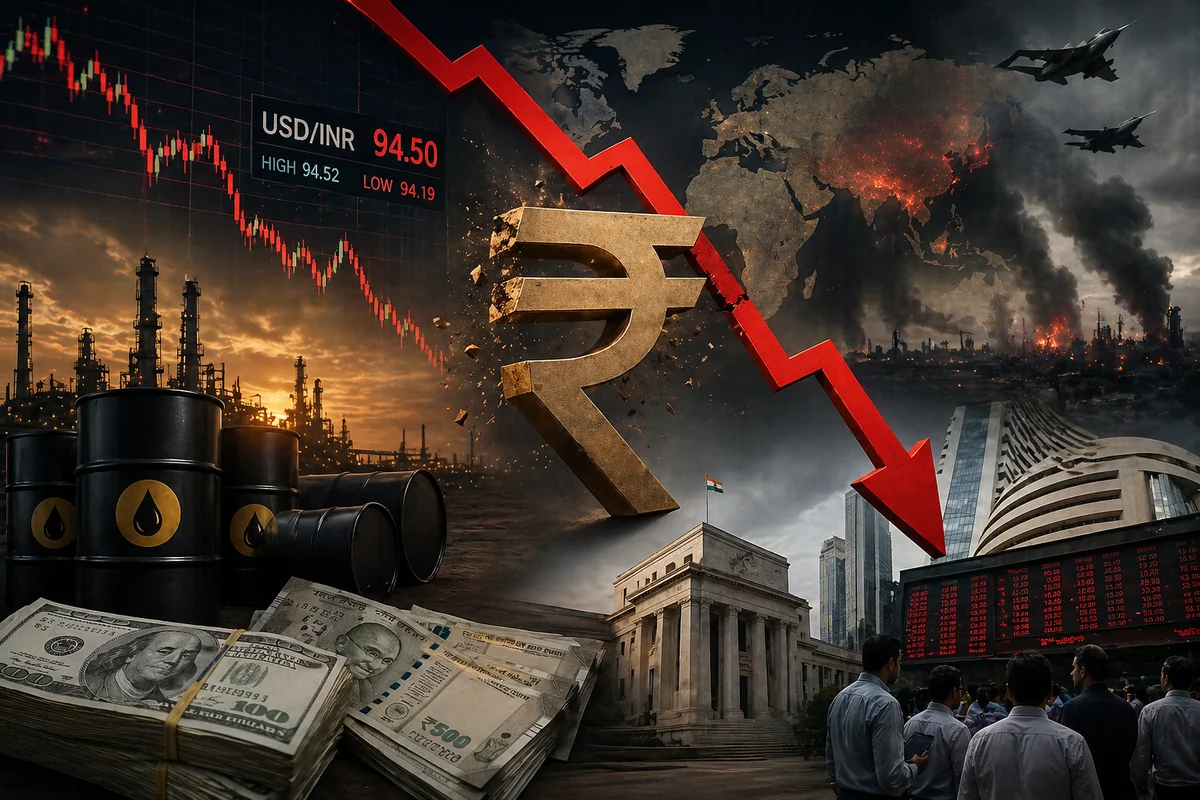
The Indian Rupee weakened to around ₹94 per US dollar on April 28, 2026, driven by rising crude oil prices, geopolitical tensions, and persistent FPI outflows. Despite RBI intervention, strong dollar demand and global uncertainty continue to pressure the rupee, indicating a sustained weakening trend with potential movement toward ₹95 levels.
Reviewed and Rewrite by
Rudransh Sangwan
The Indian Rupee (INR) is trading near ₹94 per US Dollar (USD), hovering close to its weakest levels in history. The current trend reflects a combination of global macro pressures, rising crude oil prices, and persistent foreign capital outflows.
This is not just a short-term fluctuation but a broader structural move driven by multiple economic forces.
As of April 28, 2026, the rupee is trading in a weak range against the US dollar.
| Metric | Value |
|---|---|
| Current Rate | ₹94.12–₹94.50 |
| Intraday High | ₹94.52 |
| Intraday Low | ₹94.19 |
| Trend | Weak INR |
| Volatility | Moderate |
The rupee has remained under sustained pressure throughout the session, indicating continued demand for dollars.
Key Takeaways
The current weakness in INR is driven by multiple interconnected factors rather than a single trigger.
Rising crude oil prices are the biggest driver of rupee weakness. India imports nearly 85 percent of its oil requirements, which increases dollar demand when prices rise.
Key Takeaways
Ongoing geopolitical issues, especially in oil-producing regions, have created uncertainty in global markets. Investors tend to move toward safer assets like the US dollar during such periods.
Key Takeaways
Foreign Portfolio Investors (FPIs) have been pulling money out of Indian equities and debt markets. This reduces dollar inflows into India, weakening the rupee further.
Key Takeaways
The Reserve Bank of India has been intervening in the forex market to prevent excessive volatility. However, intervention can only slow the fall, not reverse the trend.
Key Takeaways
The rupee has shown a clear weakening trend over the past month.
| Period | Range | Trend |
|---|---|---|
| Last 7 Days | ₹92.60–₹93.80 | Gradual fall |
| Last 30 Days | ₹92.25–₹94.82 | Weakening INR |
Key Takeaways
The rupee has depreciated steadily throughout 2026.
| Month | USD/INR |
|---|---|
| Jan 2026 | ₹89.5 |
| Feb 2026 | ₹91.0 |
| Mar 2026 | ₹95.2 |
| Apr 2026 | ₹94+ |
Key Takeaways
The rupee has been on a long-term depreciation path against the dollar.
| Year | USD/INR |
|---|---|
| 2010 | ₹45 |
| 2015 | ₹63 |
| 2020 | ₹75 |
| 2023 | ₹82 |
| 2026 | ₹94+ |
Key Takeaways
From a trading perspective, key levels are critical for near-term movement.
| Level Type | Range |
|---|---|
| Support | ₹93.50–₹93.80 |
| Resistance | ₹94.50–₹94.80 |
Key Takeaways
The weakening rupee has multiple implications across sectors and daily life.
Key Takeaways
Key Takeaways
The outlook for INR remains cautious given current global conditions.
Key Takeaways
The rupee’s weakness near ₹94 is not just a temporary move. It reflects a combination of structural issues, global macro pressures, and event-driven shocks.
The current trend suggests that unless oil prices cool and capital flows return, the rupee may continue to remain under pressure in the near term.
The rupee is weak mainly due to rising crude oil prices, strong demand for the US dollar, and continuous foreign investor outflows, which increase pressure on India’s currency
India imports most of its oil, so when crude prices rise, the country needs more dollars to pay for imports, which weakens the rupee against the dollar
The RBI intervenes by selling dollars in the forex market to control volatility, but it can only slow down the fall and cannot completely stop the rupee from weakening
If oil prices remain high and foreign capital outflows continue, the rupee could move toward ₹95 or even higher levels in the short to medium term
A weaker rupee makes imports like fuel, electronics, and travel more expensive, which can increase inflation and overall cost of living
Not entirely, as a weaker rupee can benefit exporters by making Indian goods cheaper globally, but it also increases import costs and inflation
Traders are closely watching resistance near ₹94.80 and support around ₹93.50, as a breakout could decide the next major move in the currency
Lower oil prices, strong foreign investments, and positive global economic conditions can help stabilize and strengthen the rupee