Loading market data...
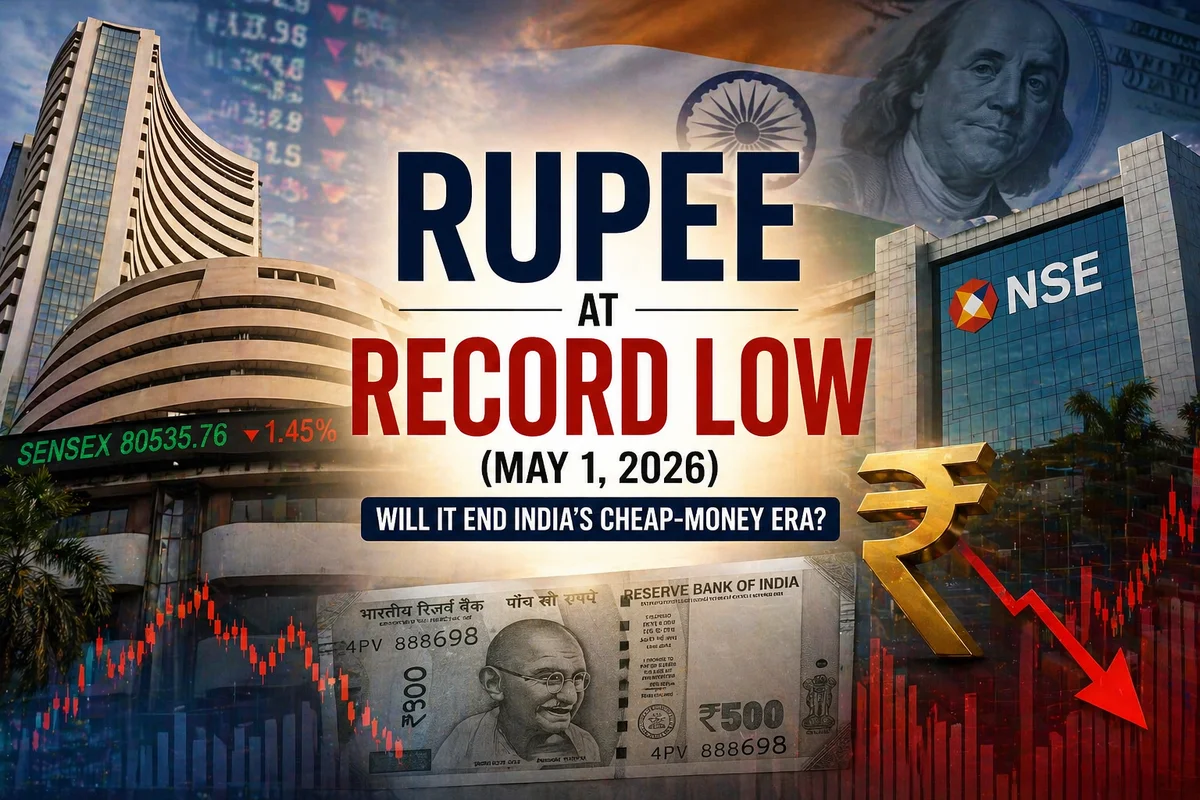
The Indian rupee’s fall toward record lows signals rising macroeconomic stress and may force the RBI to end its cheap-money policy, potentially leading to higher interest rates and tighter financial conditions
Reviewed and Rewrite by
Rudransh Sangwan
India’s currency story has entered a critical phase as the Indian Rupee hovers near record lows against the US dollar. The sharp depreciation is not just a currency event it could signal a turning point for India’s low-interest rate cycle, forcing policymakers to rethink their growth strategy.
The rupee has weakened significantly, breaching key psychological levels and nearing the ₹95 per dollar mark, with risks of moving toward ₹100 if pressures persist.
| Metric | Value |
|---|---|
| Current Range | ₹94.5 – ₹95+ |
| Trend | Weakening |
| 2-Year Decline | ~12% |
| Key Risk Level | ₹100/USD |
The currency weakness is largely driven by rising crude oil prices, capital outflows, and global geopolitical tensions.
Key Takeaways
The fall in the rupee is the result of multiple macroeconomic forces converging at once.
Rising crude oil prices especially amid disruptions around the Strait of Hormuz have sharply increased India’s import bill. At the same time, foreign investors have been pulling money out of Indian markets, reducing dollar inflows.
This combination is creating sustained downward pressure on the currency.
Key Takeaways
The Reserve Bank of India now faces a difficult choice.
On one hand, it has been supporting growth through low interest rates and high liquidity. On the other hand, a falling rupee and rising inflation may force it to tighten policy.
Governor Sanjay Malhotra has indicated a preference to manage inflation expectations rather than aggressively hike rates but market conditions may limit that flexibility.
Key Takeaways
India’s “cheap-money” phase marked by low interest rates and abundant liquidity may be nearing its end.
Since late 2024, the RBI had injected massive liquidity and cut borrowing costs to support growth. However, much of this liquidity has flowed out due to global capital shifts.
Now, if the rupee continues to weaken, interest rate hikes may become unavoidable to stabilize the currency and prevent further capital flight.
Key Takeaways
Higher interest rates could have a direct impact on India’s credit cycle.
Until recently, credit growth was strong at around 14.5%, but tighter monetary conditions could slow lending. Banks may become more cautious, especially in lending to MSMEs and riskier segments.
State-run banks, which have higher exposure to small businesses, may face additional stress if economic conditions worsen.
Key Takeaways
The weakening rupee and rising oil prices are likely to push inflation higher.
While inflation was relatively controlled at around 3.4%, risks are increasing due to:
If inflation accelerates, the RBI may have no choice but to tighten monetary policy.
Key Takeaways
Foreign investors have already pulled out significant capital from Indian markets.
A weaker rupee could accelerate this trend, further pressuring both the currency and equity markets.
Key Takeaways
The fall of the Indian Rupee is more than just a currency issue it marks a potential turning point in India’s economic cycle.
If current trends continue, the era of easy money may give way to tighter financial conditions, higher borrowing costs, and slower credit growth. The coming months will be crucial in determining whether India can balance growth with macroeconomic stability.
Due to rising oil prices, capital outflows, and global geopolitical tensions
There is a strong possibility if inflation and currency pressure persist
A period of low interest rates and high liquidity to support economic growth
Loans may become more expensive, increasing EMIs and borrowing costs
If oil prices remain high and capital outflows continue, it is possible