Loading market data...
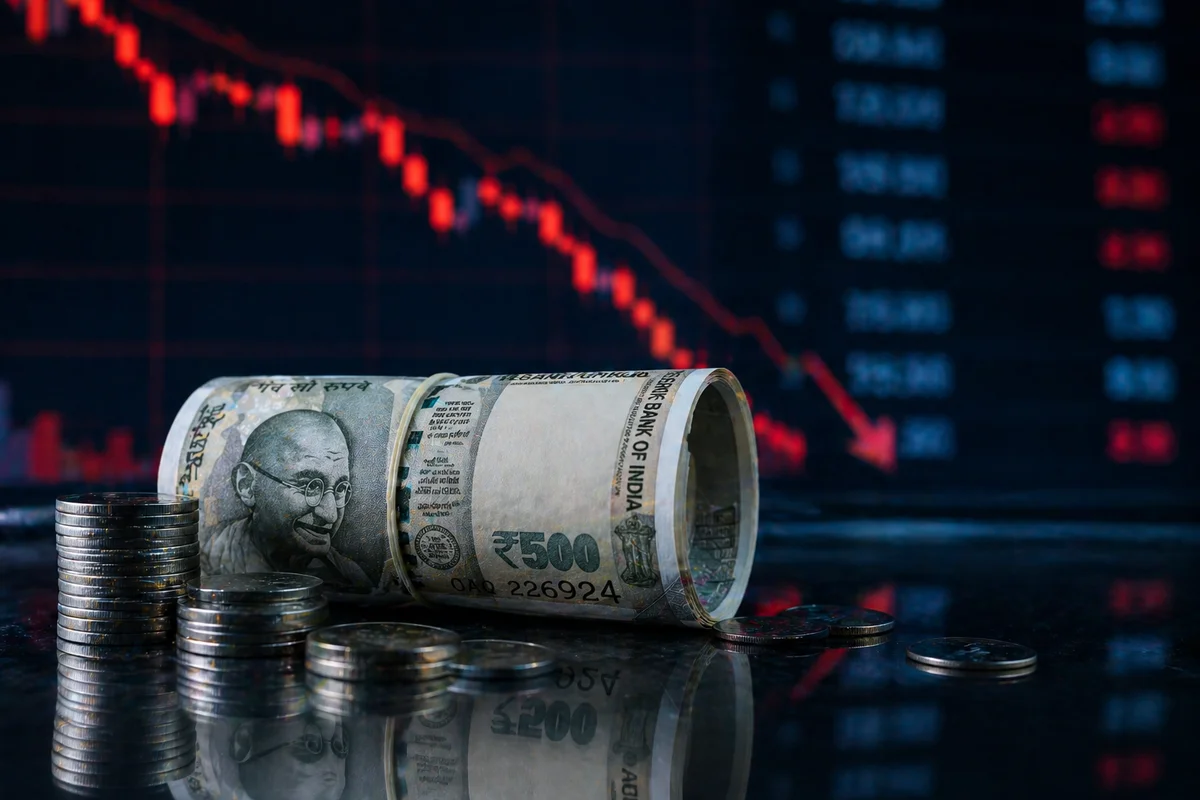
The Indian rupee fell to a record low of ₹95.31 against the US dollar, pressured by rising crude oil prices, geopolitical tensions, and continued foreign capital outflows. While the weakness reflects global macro stress, its future direction will largely depend on oil prices, US monetary policy, and capital flow trends.
Reviewed and Rewrite by
Rudransh Sangwan
The Indian currency faced intense pressure in early trade, with the rupee opening at a record low of ₹95.31 against the US dollar, down about 0.23 percent from the previous session. The sharp depreciation highlights growing stress in India’s external sector, driven by a combination of global geopolitical risks, rising crude oil prices, and sustained foreign capital outflows.
The recent move is not an isolated event but part of a broader weakening trend. The rupee has been consistently hitting new lows in recent sessions, marking a historic depreciation phase.
| Parameter | Value |
|---|---|
| Opening Level | ₹95.31/USD |
| Recent Weak Levels | ₹95+ range |
| 2026 Trend | Depreciation phase |
| Key Trigger | Oil + Capital Outflows |
Data suggests sustained external pressure on the rupee This leads to higher demand for dollars Which results in continued currency depreciation
India is one of the world’s largest oil importers, and rising crude prices have a direct impact on the currency. Oil prices have surged above $100 per barrel amid Middle East tensions, increasing India’s import bill and dollar demand.
Higher oil prices lead to
The ongoing US-Iran conflict and risks around the Strait of Hormuz have created uncertainty in global markets. Since this route handles a major portion of global oil supply, any disruption directly impacts currencies of oil-importing nations like India.
Foreign investors have been pulling money out of Indian markets at a significant pace in 2026. These outflows weaken demand for the rupee and increase pressure on the currency.
A stronger US dollar, supported by elevated US bond yields and a cautious Federal Reserve stance, has reduced the attractiveness of emerging market currencies.
This creates a capital flow imbalance
The rupee’s depreciation has wide-ranging implications across sectors.
| Sector | Effect |
|---|---|
| Oil & Energy | Higher import costs |
| Aviation | Increased fuel expenses |
| FMCG | Margin pressure |
| IT | Positive (export benefit) |
Export-oriented sectors like IT may benefit from a weaker rupee, while import-heavy sectors face cost pressures.
One important but less visible factor is the role of the Reserve Bank of India in managing volatility.
The RBI has been actively intervening through
Despite these efforts, the scale of global pressures has limited the effectiveness of short-term interventions.
Many assume that a falling rupee always indicates economic weakness.
This is not entirely accurate.
Currency depreciation can also be influenced by
In some cases, a weaker currency can actually support exports and improve competitiveness.
While the current trend looks negative, the rupee’s trajectory is highly sensitive to oil prices.
If crude prices fall below key levels
This means the rupee’s weakness is not entirely structural and could reverse with improving global conditions.
| Factor | Impact |
|---|---|
| Oil price movement | Critical |
| US Fed policy | High |
| FPI flows | High |
| Geopolitical developments | Critical |
Analysts suggest that if geopolitical tensions persist and oil remains elevated, the rupee could weaken further toward higher levels in extreme scenarios.
The rupee’s fall to a record low of ₹95.31 reflects a convergence of global shocks rather than purely domestic weakness. Rising oil prices, geopolitical uncertainty, and capital outflows have created a high-pressure environment for the currency. While short-term volatility is likely to persist, the long-term trajectory will depend heavily on global energy markets and policy responses. Investors and businesses that adapt with disciplined risk management will be better positioned to navigate this phase.
The rupee weakened due to rising crude oil prices, geopolitical tensions, strong dollar demand, and foreign investor outflows.
It has mixed effects. It increases import costs but can benefit exports and improve competitiveness in global markets.
Yes, if oil prices stabilize, capital flows improve, and global uncertainties ease, the rupee could recover.