

commodity
Kotak Securities Predicts Crude Oil Prices Could Surge to $120 Amid Global Tensions
13 hours ago
Reviewed and Rewrite by
Reetesh Kumar


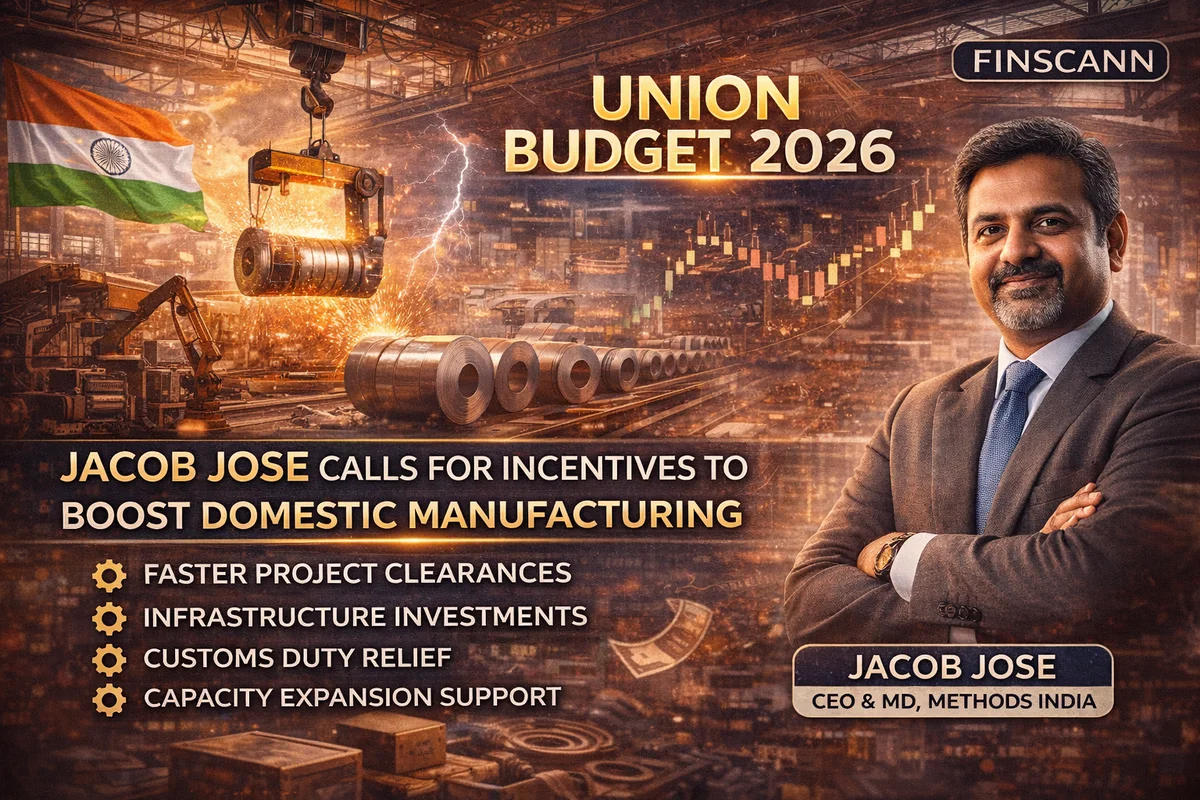
As the countdown to the Union Budget 2026 begins, the domestic manufacturing and capital goods sector is looking for more than just broad subsidies. Jacob Jose, the CEO and Managing Director of Methods India, has emerged as a key voice for the industry, advocating for a strategic shift from generic support to "precision policy" that targets the specific friction points of the engineering sector.
Empowering the 'Make in India' Backbone: Methods India CEO Jacob Jose Lays Out a Vision for Budget 2026
As the countdown to the Union Budget 2026 begins, the domestic manufacturing and capital goods sector is looking for more than just broad subsidies. Jacob Jose, the CEO and Managing Director of Methods India, has emerged as a key voice for the industry, advocating for a strategic shift from generic support to "precision policy" that targets the specific friction points of the engineering sector.
With India's infrastructure momentum in full swing, Jose argues that the upcoming budget on February 1, 2026, must prioritize execution efficiency and cost competitiveness to truly cement India’s position as a global manufacturing hub. This sentiment aligns with broader market analysis suggesting that balancing growth and fiscal discipline is key for the upcoming budget.
1. The Efficiency Manifesto: Clearances and Capex
For large-scale engineering and turnkey projects, time is literally money. Jacob Jose highlights that infrastructure momentum can only be sustained if administrative hurdles are removed.
2. Rationalizing Costs: The Customs Duty Play
One of the most critical demands from Methods India is the rationalization of customs duties. In an era of fluctuating global commodity prices, the cost of raw materials can make or break an engineering firm’s margins.
3. Scaling Responsibly: Incentives for Capacity Expansion
Rather than broad subsidies, Jose is pushing for targeted incentives that reward companies for scaling up their physical and technological infrastructure.
| Recommendation | Intended Impact |
|---|---|
| Accelerated Depreciation | Encourages immediate investment in modern plant & machinery. |
| Export Financing | Easier access to credit for companies bidding on large international contracts. |
| Timely Public Sector Payments | Resolves the working capital "crunch" in large turnkey projects. |
4. Solving the Cash Flow Crunch
A recurring pain point for Indian engineering firms is the delay in payments from public sector projects. Jose highlights that timely payments are "vital" for maintaining the liquidity required to execute large-scale, multi-year contracts. He suggests that the budget should introduce performance-related payment milestones that are strictly adhered to by government agencies.
Looking Ahead: Building the Industrial Backbone
The "Methods India" vision for Budget 2026 is clear: the government should shift focus from "Asset Creation" to "System Efficiency." By improving the ease of doing business and lowering logistics costs through better port and rail connectivity, the government can help domestic firms move up the value chain from mere fabricators to end-to-end solution providers.
FinScann Take:
Jacob Jose’s recommendations reflect a mature manufacturing sector that is ready to compete globally but needs the "shackles" of administrative delays and cost inefficiencies removed. If the Union Budget aligns with these goals, the capital goods sector could see its strongest growth cycle in a decade.