Loading market data...
Reviewed and Rewrite by
Reetesh Kumar
The Yen "Danger Zone": Japan’s Tightrope Walk and the Global Liquidity Scare
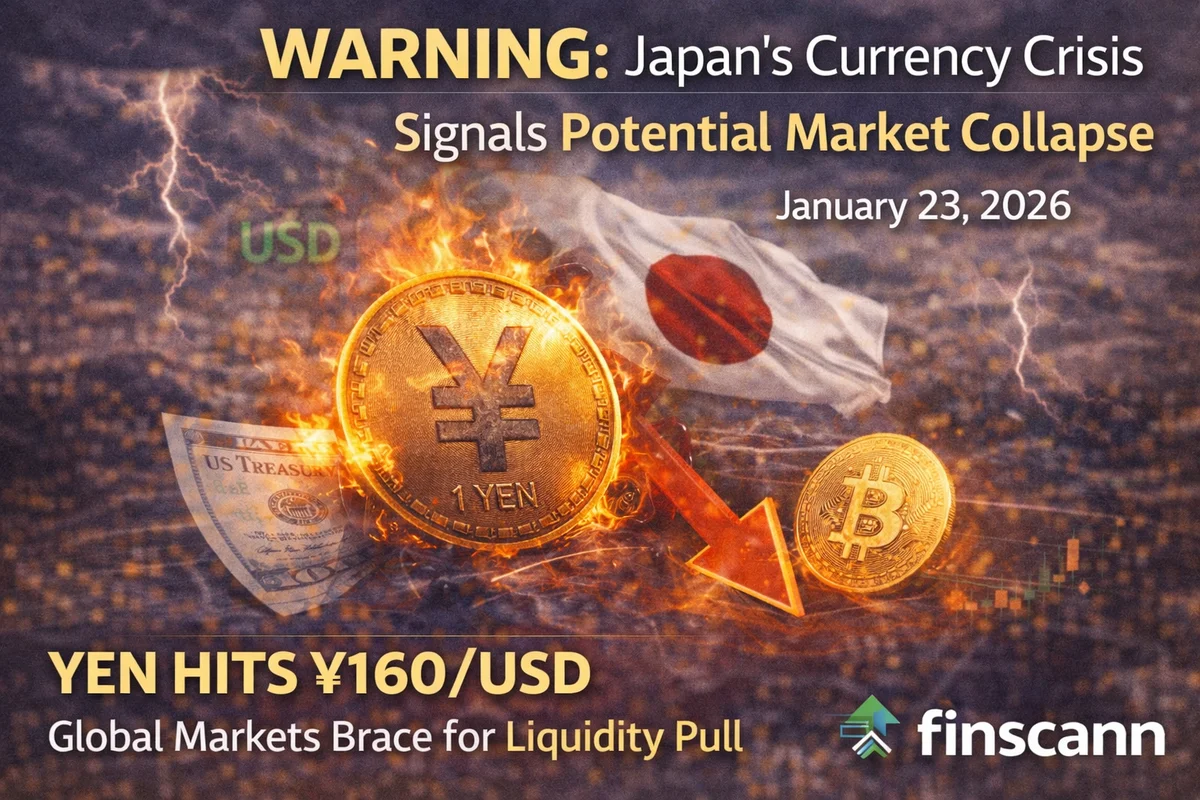
A viral warning from macro strategists is currently circulating through the financial community, claiming a potential "market collapse" triggered by Japan’s mounting currency crisis. While the term "collapse" is often used to capture headlines, the underlying mechanics are grounded in very real, high-stakes economic data as of January 23, 2026.
As the Japanese Yen (JPY) hovers near the critical 160 level against the US Dollar—its weakest point in decades—the global financial system is bracing for a "liquidity pull" that could impact everything from US Treasuries to Bitcoin.
1. The "160 Pain Level": Why Tokyo is Acting
In the world of foreign exchange, 160 is not just a number; it is a psychological and political "line in the sand."
2. The BoJ’s Impossible Choice: Bullish or Bearish?
By keeping rates at 0.75% today, Governor Kazuo Ueda opted for stability over a "shock" hike.
3. The "US Treasury Headline": Connecting the Dots
The danger isn't just in the currency; it’s in how Japan pays for its intervention. Japan is the largest foreign holder of US Treasuries, with a stash of approximately $1.2 trillion.
To strengthen the Yen, Japan must:
4. Bond Market Stress: The Breaking "Anchor"
Japanese Government Bond (JGB) yields are at "abnormal" levels. For decades, Japan was the "anchor" of global low interest rates. That anchor has now been lifted.
| Maturity | Yield (Jan 23, 2026) | Significance |
|---|---|---|
| Japan 10Y | 2.26% - 2.38% | 27-year high; challenges the global "low rate" era. |
| Japan 40Y | 3.94% - 4.23% | Reflects deep fiscal anxiety and high inflation. |
| USD/JPY | ~158.50 | The "Danger Zone" where intervention becomes imminent. |
5. Impact on Stocks and Crypto
Why do macro analysts mention Bitcoin? Because crypto is often the "canary in the coal mine" for global liquidity.
FinScann Take: Is a "Collapse" Imminent? The BoJ is caught in a classic liquidity trap. If they raise rates too fast, they crush their own debt-heavy economy; if they don't, the weak Yen fuels runaway inflation. The most likely outcome isn't a "collapse" but a prolonged period of thin liquidity and "flash" volatility.
Investors should watch the 160 level and US 10-year yields—if both rise simultaneously while Japan is selling, the "liquidity drain" will become a very dangerous reality for your portfolio.