

commodity
Kotak Securities Predicts Crude Oil Prices Could Surge to $120 Amid Global Tensions
13 hours ago
Reviewed and Rewrite by
Reetesh kumar


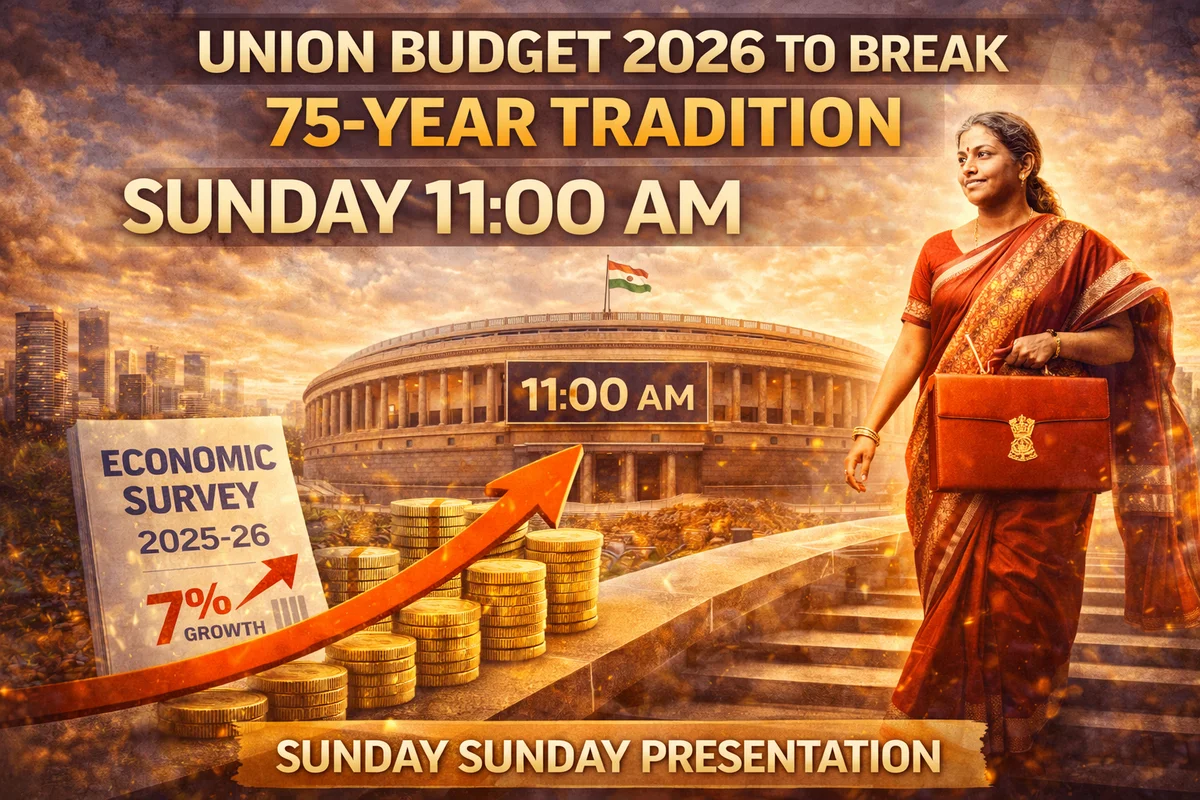
On February 1, 2026, Finance Minister Nirmala Sitharaman will deliver India’s first-ever Sunday Union Budget, a move that breaks a 75-year tradition to signal a new era of "procedural permanence" and market readiness. Following a robust 7% GDP growth projection from the Economic Survey, the strategy centers on "Strategic Hedging" to protect the domestic economy from global trade volatility and "tariff wars." The government is expected to target a disciplined fiscal deficit of 4.3%–4.5% while fueling a record ₹12.5 lakh crore Capex drive, specifically focused on Kavach 4.0 (Railway safety), Sovereign AI, and Defence indigenization. For the middle class, rumors of increasing the Standard Deduction to ₹1,00,000 and potentially raising the LTCG exemption to ₹2 lakh aim to boost consumption and equity participation.
Tomorrow morning at 11:00 AM, Finance Minister Nirmala Sitharaman will step into Parliament to deliver a speech that breaks a 75-year-old tradition. For the first time in independent India’s history, the Union Budget will be presented on a Sunday.
This shift is more than just a calendar quirk; it is a signal of "procedural permanence" over colonial-era conventions. With the Economic Survey 2025-26 projecting a robust 7% growth trajectory despite a global "tariff war" climate, Budget 2026 is expected to be a masterclass in strategic hedging—balancing domestic consumption with a high-octane manufacturing push.
1. The Macro-Fiscal Strategy: Precision over Populism
The government is likely to double down on fiscal discipline while ensuring the "Capex engine" doesn't stall.
2. Personal Finance: Boosting the "Take-Home" Pay
While a complete overhaul of the New Tax Regime (NTR) is unlikely after last year’s major revisions, targeted relief for the middle class is on the cards.
3. Sectoral "Gainers" vs. "Losers" Matrix
The market has already begun "pre-pricing" the winners and losers based on the Economic Survey’s hints.
| Sector | Key Focus / Expected Trigger | Top Stocks to Watch |
|---|---|---|
| Defence | 15% Budget hike; focus on "Atmanirbhar" exports. | HAL, BEL, Mazagon Dock |
| Railways | ₹2.65 lakh crore allocation; Kavach 4.0 expansion. | RVNL, IRFC, Titagarh Rail |
| Energy | PLI expansion for Green Hydrogen & Solar. | Tata Power, IREDA, Suzlon |
| Consumption | Rural fund boost & Standard Deduction hike. | HUL, Dabur, Tata Motors |
| Luxury Goods | Potential "Green Cess" or import duty hikes. | Titan, Luxury Real Estate |
4. The "Part B" Evolution: A Roadmap to 2047
In a significant departure from tradition, Finance Minister Sitharaman is expected to utilize Part B of her speech—usually a dry list of tax tweaks—to unveil a comprehensive "Viksit Bharat 2047" Roadmap. This section will likely outline structural reforms in agriculture, sovereign AI frameworks, and "Make in India 2.0" to insulate the economy from global supply chain shocks.
The FinScann Verdict: "Own Assets or Be Left Behind"
Budget 2026 is set against a backdrop where commodities (Copper, Gold, Silver) are hitting record highs. The government’s strategy appears to be a pivot toward hard assets and domestic manufacturing depth, ensuring India remains an "oasis of stability" in a volatile global market.
Important Disclaimer
Volatility Warning: Budget Day (even on a Sunday) usually witnesses high volatility in the GIFT Nifty and global ADRs. No Financial Advice: This article is for informational purposes. Predictions regarding tax slabs, sectoral hikes, or stock targets are based on analyst consensus and "Economic Survey" leads and are subject to change during the actual speech. Consult a Pro: Please consult a SEBI-registered financial advisor before making any "Budget-bet" trades.