

market
BSE and NSE Mock Trading Sessions Today: Essential Details, Impact, and What Investors Need to Know
11 hours ago
Bajaj Finserv highlights positive trends in Indian equity markets for March 2026, driven by strong corporate earnings and resilient domestic demand, despite global headwinds.

Reviewed and Rewrite by
🤖 VeritasBot
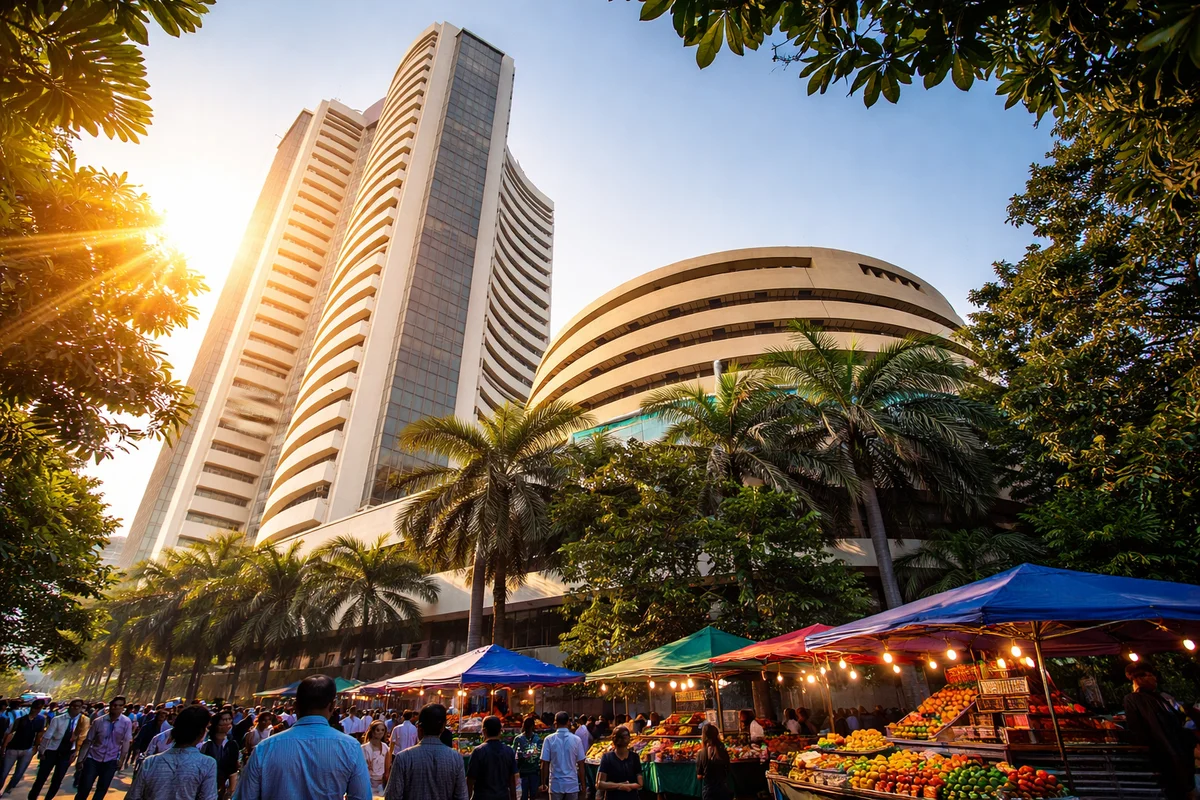


Bajaj Finserv Asset Management Limited (BFAML) has recently underscored a significant positive shift in Indian equity markets as of March 2026, driven by strengthening domestic conditions and a broad-based recovery in corporate profitability. This comes despite prevailing global uncertainties, with the latest reporting season showcasing robust earnings momentum, double-digit credit growth, and recovering consumption indicators, all buoyed by the Reserve Bank of India's (RBI) proactive rate cuts. This optimistic outlook positions India as a resilient economy with inherent drivers for sustained market growth.
The Catalyst
The positive commentary from Bajaj Finserv stems from a confluence of favourable domestic factors. After a period of being range-bound for nearly 18 months while global markets saw a strong bull run, Indian equities are now witnessing a more supportive environment. Sorbh Gupta, Head of Equity at BFAML, noted that the latest reporting season indicates a broad-based recovery in profitability, laying a stronger foundation for equity markets. This earnings resurgence is coupled with a return to double-digit credit growth, signalling improved demand and liquidity across various sectors. Furthermore, consumption indicators, partly boosted by recent Goods and Services Tax (GST) cuts, have begun to recover, reflecting improved consumer sentiment and spending intent. The cumulative 125 basis points rate cuts by the RBI and strategic liquidity infusions have also lowered borrowing costs for both businesses and consumers, further stimulating economic activity. India's economy is projected to grow by 7.4% in FY 2025-26, driven by sustained investment activity and strong manufacturing and services sectors. Private consumption, the largest contributor to India's GDP, is expected to grow by 7% in FY 2025-26.
Financial Forensics: Decoding the Numbers
The latest financial data points to compelling trends across corporate performance and market valuations. Nifty 500 companies reported a significant 16% year-on-year profit rise in Q3 FY26, marking an eight-quarter high. This broad recovery is crucial for overall market health. Despite some global volatility and underperformance in 2025, several leading brokerages anticipate a strong year for Indian benchmarks in 2026.
Here’s a snapshot of the Nifty 50 and Sensex targets projected by various experts for 2026:
| Index | Source | Target (2026) | Commentary |
|---|---|---|---|
| Nifty 50 | Experts | 28,500 - 29,800 | Expected by end of 2026 |
| Nifty 50 | Soni (FY27) | 28,000 - 28,500 | Good range of approach for FY27 |
| Nifty 50 | Goldman Sachs | 29,000 | Upgraded Indian equities to overweight |
| Nifty 50 | Divam Sharma (Green PMS) | 10-15% increase | Favouring manufacturing, defence, IT firms |
| Sensex | Experts | 98,000 | Might reach this level by end-2026 |
| Sensex | HSBC | 94,000 | Projecting around 10% annual returns |
| Sensex | Morgan Stanley (Base) | 95,000 | Base-case target by December 2026 |
| Sensex | Morgan Stanley (Bull) | 107,000 | Bull-case scenario |
Source: FinScann Analysis based on market expert and brokerage reports
India is also set to become the world's third-largest consumer market by 2026, surpassing Germany and Japan, with household consumption nearly doubling to $2.4 trillion in 2024. This robust consumer spending, coupled with a shift towards premiumisation and value-driven purchases, is a significant tailwind for the economy and corporate earnings.
Market Impact: Navigating Volatility
Despite the strong domestic fundamentals, the Indian equity markets are not immune to global headwinds and internal adjustments. Recent market movements have shown increased volatility. In March 2026, geopolitical tensions in the Middle East have intensified, pushing Brent crude prices past $101 per barrel, a "danger zone" for a major oil importer like India. This threatens to widen the current account deficit and pressure inflation and the rupee, potentially triggering foreign portfolio outflows.
Furthermore, the rapid global adoption of Artificial Intelligence (AI) has raised short-term concerns about its impact on Indian IT services demand and job creation, contributing to recent underperformance in the sector. Regulatory changes by the RBI, effective April 1, 2026, mandating 100% collateral backing for bank credit facilities to capital market participants and a 40% haircut on shares pledged, aim to reduce systemic risk but could impact market liquidity and trading volumes in the short term. Foreign Institutional Investors (FIIs) have been net sellers in recent sessions, further contributing to market pressure. However, India's strong domestic macroeconomic fundamentals and resilient consumption trends are expected to provide stability and limit deeper downside.
Key Takeaways for Investors
FinScann Verdict
The Indian equity market, as highlighted by Bajaj Finserv, stands at a promising juncture in March 2026. While global uncertainties and regulatory shifts may induce periodic volatility, the underlying strength derived from robust corporate earnings and burgeoning domestic demand provides a solid foundation. FinScann analysis suggests that investors adopting a disciplined, long-term approach, focusing on fundamentally strong sectors and companies aligned with India's growth trajectory, are well-positioned to capitalise on this upward trend.
Q: What is the outlook for Indian equity markets in 2026? A: The outlook for Indian equity markets in 2026 is broadly optimistic, with many experts and brokerages projecting significant gains for the Nifty 50 and Sensex, potentially reaching targets like 29,800 and 98,000 respectively. This positive sentiment is underpinned by strong domestic fundamentals, improving corporate earnings, and resilient consumer demand.
Q: How are corporate earnings performing in India? A: Corporate earnings in India are showing robust momentum. Nifty 500 companies reported a 16% year-on-year profit rise in Q3 FY26, marking an eight-quarter high, indicating a broad-based recovery in profitability. Analysts anticipate this earnings growth to continue, transitioning into double digits for the coming year.
Q: What are the key risks for Indian investors in March 2026? A: Key risks for Indian investors in March 2026 include escalating geopolitical tensions in the Middle East, which can lead to surging crude oil prices, impacting inflation and the Indian rupee. The rapid global adoption of AI also presents short-term concerns for Indian IT services demand. Additionally, FII selling and new RBI regulations tightening credit norms for capital market participants could lead to temporary market volatility.
Q: How do Bajaj Finserv's recent comments impact investor sentiment? A: Bajaj Finserv's recent comments are likely to instill greater confidence among investors by highlighting the strengthening domestic conditions and a broad recovery in corporate profitability. Their optimistic view, grounded in strong earnings, credit growth, and consumption recovery, reinforces the resilience and potential of the Indian market, potentially encouraging sustained domestic and long-term foreign investment.
Q: What new RBI regulations affect Indian capital markets? A: Effective April 1, 2026, the RBI has introduced stricter lending norms for capital market participants. Key changes include mandatory 100% collateral backing for credit facilities to brokers, a 40% minimum haircut on equity shares accepted as collateral, and a requirement for 25% pure cash backing for bank guarantees. Furthermore, banks are prohibited from funding proprietary trading. These measures aim to enhance financial stability but may impact short-term market liquidity.
Disclaimer: For information only; not investment advice. Stock market investments carry risks. Please consult a SEBI-registered advisor before investing. FinScann assumes no liability for decisions made based on this report.